

Heads Down
This morning, while out walking, I found myself playing a familiar game: count the people looking at their phones.
Not sitting on a bench. Not stopped at the side of the path. Walking.
Heads down. Shoulders rounded. Eyes fixed on a screen.
A few nearly walked into me.
Now, I know this can easily become another “young people and their phones” rant, except it isn’t. The people I saw were all ages. Teenagers. Commuters. Dog walkers. Retirees. We’re all at it.
And what struck me wasn’t the annoyance.
It was the posture.
Small habits become big habits
One of my favourite ideas is that small things count.
They always have.
We often think change arrives dramatically, with a grand gesture, a new gym membership, or a life-changing decision. More often, though, our bodies and minds are shaped by the tiny things we do repeatedly.
Looking down at a phone for a few seconds is harmless.
Doing it for minutes becomes normal.
Doing it every day becomes a habit.
Doing it for years becomes the way your body expects to exist.
The human body is brilliant at adapting. That’s one of its superpowers. But adaptation isn’t always helpful.
If you spend enough time with your head slightly forward and down, your muscles, joints and connective tissues begin to accommodate that position. The posture starts to feel natural. Looking ahead can start to feel like effort.
The body isn’t trying to harm you.
It’s trying to help.
It’s simply responding to the instructions you give it most often.
Your spine was designed with curves
The spine isn’t meant to be perfectly straight. It has natural curves that help distribute forces, maintain balance and allow movement. Good posture isn’t about standing like a guardsman outside Buckingham Palace. It’s about allowing those natural curves to do their job.
According to NHS physiotherapy guidance, the spine functions best when its natural curves are maintained, with muscles continuously making small adjustments throughout the day. Regular movement is important because the spine was never designed to stay in one position for long. [nhsfife.org]
The problem isn’t that we occasionally look down.
The problem is that some of us hardly ever look up.
A personal reminder
I have a relative who developed dropped head syndrome.
Her situation wasn’t caused by phone use. It was neurological and came on suddenly.
She physically cannot hold her head upright without support in the way most of us take for granted.
What struck me was the effort required afterwards. Not just medically, but physically and mentally.
The challenge became helping the muscles remember what “looking forward” felt like.
Because if muscles stop being used, the body quite reasonably concludes they’re no longer needed.
The lesson stayed with me.
You have to train the things you want your body to do.
If you don’t, your body will find its own way.
Tech neck is becoming a thing
Healthcare professionals increasingly talk about “tech neck” or “text neck”, the strain associated with prolonged periods spent looking down at phones and tablets.
The Royal Orthopaedic Hospital has highlighted growing concerns about young people developing neck and shoulder pain through extended use of handheld devices. Physiotherapists there note that the issue is often less about the position itself and more about how long we stay in it. Habits become ingrained, tissues become overloaded, and inactivity compounds the problem. [roh.nhs.uk]
Similarly, NHS advice on neck pain lists poor posture and remaining in the same position for long periods among common contributors to neck discomfort. [nhs.uk]
That doesn’t mean every glance at your phone is causing irreversible damage.
But it does mean our bodies appreciate variety.
Movement is medicine.
Is It just a numbers game?
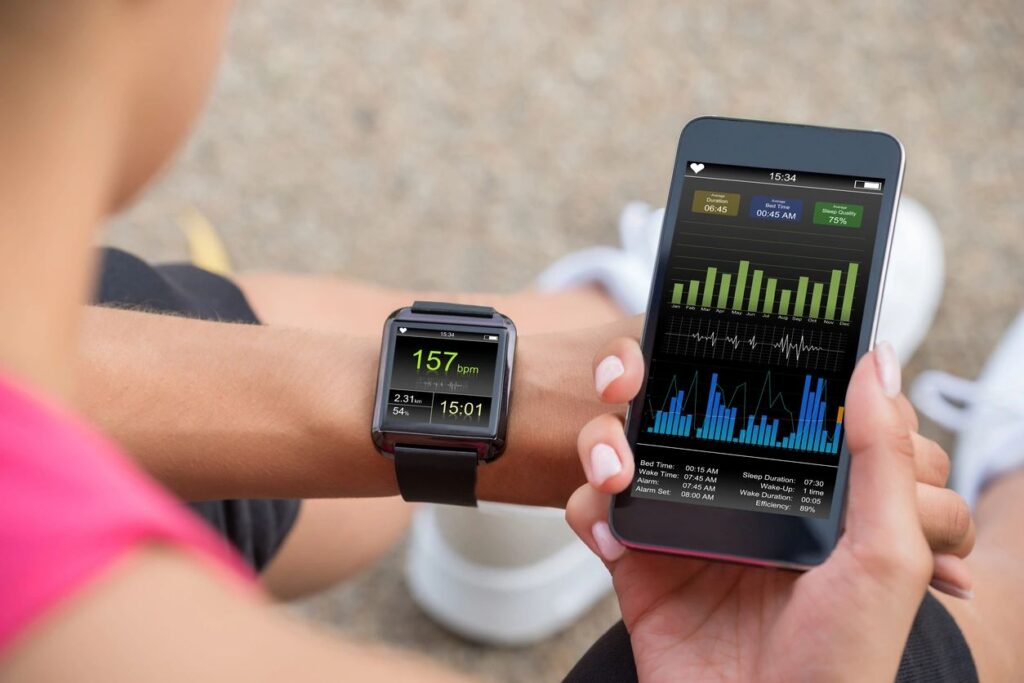
We live in an age of dashboards.
Steps.
Sleep.
Calories.
Heart rate.
Screen time.
Every app wants to tell us how we’re doing.
Every week my phone helpfully tells me how much time I’ve spent staring at it.
Sometimes the notification feels like a gentle pat on the back.
“You spent less time on your phone this week.”
I’ll take the win.
Other weeks it feels more like a quiet scolding.
What I’ve started wondering, though, isn’t just how long I’m on my phone. It’s what else I’m doing at the same time.
My fitness apps tell me how much I’ve walked.
They tell me how much I’ve exercised.
They tell me how much I’ve slept.
My phone tells me how long I’ve been using it.
Add all those numbers together and some days it feels like they should exceed 24 hours.
Which raises an interesting question.
How much of our lives are we trying to do two things at once?
Walking while looking at a phone.
Commuting while scrolling.
Eating while replying to messages.
Watching television while checking notifications.
We know that every activity has a recommended timescale.
Public health guidance encourages us to be active each week.
Some people build on that and head to the gym most days. We invest time in improving our fitness, our strength and our health.
But what if we’re simultaneously spending hours teaching our body something else?
The funny thing is that my fitness app and my phone report both claim the same hour.
Apparently I was exercising and scrolling at exactly the same time.
Which makes me wonder which habit was getting the most training.
An hour spent exercising is still an hour spent exercising.
A walk is still a walk.
The steps still count.
Yet our bodies learn from repetition, not intention.
If we spend hours every day with our heads down, shoulders rounded and eyes on a screen, we’re training that position too.
Not because our bodies are working against us.
Because they’re doing exactly what bodies do: adapting to the demands we place on them most often.
Perhaps that’s why the phone report and the fitness report feel so interesting when viewed side by side.
One tells us how we’re investing in our health.
The other reveals the habits we’re practising when we’re not thinking about them.
Maybe the issue isn’t the technology at all.
Maybe it’s that we’re becoming experts at being somewhere other than where we actually are.
If you’re on a walk, be on the walk.
Look up.
Notice the season.
Notice the light.
The steps will still count.
But so will the moment
Look up. You’re missing the world.

What really makes me sad isn’t the neck pain.
It’s what people aren’t seeing.
The early morning light.
The trees changing with the seasons.
The dog that desperately wants you to throw a ball.
The unusual building you’ve passed a hundred times without noticing.
The funny interaction between strangers on a train.
The stories you can invent about fellow commuters.
The podcast that only needs your ears, not your eyes.
The moment you’re actually living.
If you’ve gone for a walk, enjoy the walk.
The phone can wait.
And if whatever was on that screen was truly important, it’ll still be there in twenty minutes.
One small thing
I’m not suggesting throwing your phone into a river.
I’m suggesting one tiny habit.
When you walk, put your phone away for the first five minutes.
That’s it.
Five minutes with your head up.
Five minutes noticing where you are.
Five minutes allowing your body to remember the position it evolved for.
The walk counts.
The gym session counts.
The run counts.
The swim counts.
The hours we spend looking after ourselves absolutely matter.
But so do the hours in between.
Our bodies don’t just respond to the moments we deliberately train them. They respond to the thousands of small repetitions we hardly notice.
The workout is a habit.
So is the posture you hold while reading this.
The walk is a habit.
So is looking at a screen while you do it.
Because small habits count.
They always have.